The One-Label Trap in Describing a Public Festival
A public festival rarely means the same thing to everyone. Learn to describe its participants, purposes and setting without flattening their differences.
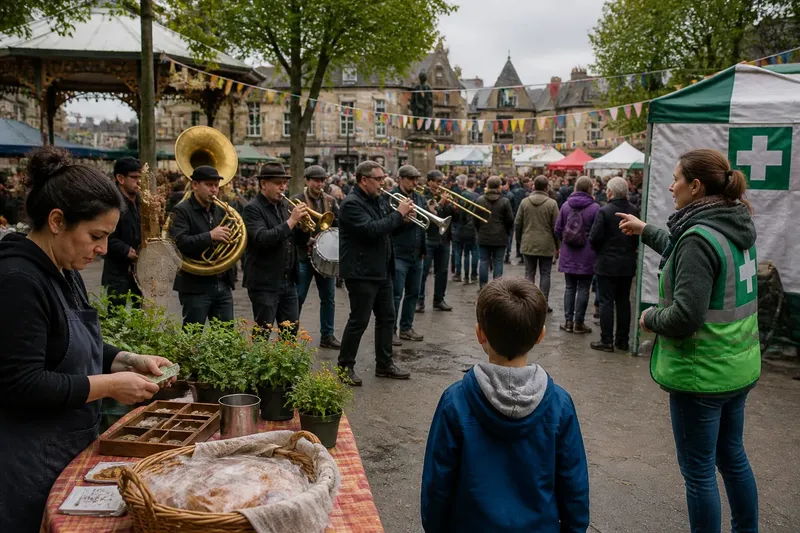
At the edge of a street festival, a child watches a brass band while a stallholder counts change and a volunteer points visitors towards a first-aid tent. Ask each person what the event is, and you may hear different answers. Describing a public festival with one label can make those differences disappear before the story has begun.
The problem is not that labels are always wrong. “Parade”, “religious celebration” or “neighbourhood festival” can orient a reader. The trap is treating one label as the whole event, as if every participant shares a purpose and every edition follows an unchanged script. A better description starts by asking what kind of account you need to make, then names the variations that matter to it.
Choose the description that fits your situation
Use this decision guide to decide which details deserve space. A concise description can still be accurate if it makes clear whose perspective it represents and what it leaves outside the frame.
- If you are writing a short caption: name the visible activity and its location, then add one clue to its wider meaning. “A lantern procession moves through the town centre during the annual spring festival” says more than “a traditional festival”, without pretending that every participant shares the same belief.
- If you are introducing the event to newcomers: explain the main public-facing purpose, such as marking a season, bringing neighbours together or inviting visitors to watch. Mention that participants may join for different reasons.
- If you are documenting participants: distinguish organisers, performers, vendors, residents and visitors where those roles shape the scene. Do not assume that someone standing in the crowd is a spectator rather than a participant.
- If you are comparing editions or locations: describe what changed in the route, programme, audience or setting. Avoid calling one version the authentic one unless you can explain whose standard of authenticity you mean.
- If the event carries religious, political or contested meaning: identify the relevant perspectives and attribute interpretations to the people or organisations expressing them. A neutral-sounding label can still conceal disagreement.
The right choice is the one that answers the reader’s question without assigning a single motive to everyone present.
Separate participants from their reasons for attending
A crowd is not a unified audience. Some people may be performing a family or community role; others may be working, volunteering, observing, selling food or simply passing through. These roles can overlap, and they do not automatically reveal anyone’s personal beliefs.
Imagine a town hosts a procession through its market square. A musician joins because a local group invited her, a shopkeeper keeps the doorway clear for customers, and a visitor pauses to watch. Calling all three “festival-goers” may suit a broad caption, but it cannot explain their different relationships to the event. A careful account would name the visible roles and avoid guessing at private motives.
When speaking with participants, ask open questions about what they are doing and what the occasion means to them. One person’s answer is a perspective, not a licence to speak for an entire community. If you cannot ask, describe what can be observed and leave intentions unstated.
Describe the purpose without forcing a single meaning
Public festivals can combine celebration, remembrance, worship, civic display, fundraising and tourism. One purpose may dominate the official programme while another matters more to a particular family or neighbourhood. These meanings can coexist without being interchangeable.
Pay attention to who presents the event and how. An organiser’s programme may call it a cultural celebration; a community group may emphasise remembrance; a visitor may see a spectacle. Attribute each description to its source rather than blending them into an all-purpose claim. If the available information supports only a broad statement, keep it broad.
Also distinguish an event’s stated purpose from its effects. A gathering organised to celebrate a local tradition may also bring customers to nearby businesses or create a place for people to meet. Those outcomes are relevant, but they do not automatically define why every participant attends.
Read the setting as part of the tradition
A festival takes shape in a particular place, and the setting affects what can happen there. A procession through a residential street meets different constraints from a stage programme in a park. Routes, permits, weather, transport, noise rules and access needs can alter the event’s form without erasing its meaning.
Look for changes in the surroundings: barriers that redirect a parade, a temporary stage that makes performances visible, or a community hall used when outdoor space is unavailable. Such details help explain why one edition differs from another. They also guard against presenting a current arrangement as the timeless form of a tradition.
For practical descriptions, state the setting plainly. If access, schedules or participation rules matter to readers, direct them to the organiser’s current information rather than relying on an old account.
Which details belong in a careful account?
How do I describe a festival in one sentence?
Name the activity, place and occasion, then add a qualification if the event has more than one purpose or audience. Keep the sentence anchored in what is visible or clearly attributed.
Can I call a festival traditional?
You can use the word if you say what makes the practice traditional in this context, such as its connection to a community or a recurring custom. Avoid using it to imply that the event has never changed.
What if participants disagree about what the festival means?
Describe the disagreement as part of the event’s public context, and identify whose views you are reporting. Do not turn one person’s account into a unanimous community position.
How can I avoid treating visitors as outsiders?
Describe what visitors do and how the event welcomes or accommodates them, rather than assuming they are detached observers. At the same time, distinguish attendance from membership or authority to speak for the community.
Use precise language instead of a single all-purpose label
Words such as “community”, “religious”, “national” and “traditional” can be useful, but each raises a question: community according to whom, religious in which practice, or traditional by whose account? Add a specific noun or attribution when the label alone could mislead. “A procession organised by local congregations” is clearer than an unsupported claim that an entire town takes part.
For a public festival description, the strongest choice is not always the longest one. It is the description that makes its limits visible: who is involved, what the event is for in the context being described, and how the place shapes it. A small qualification can prevent a vivid scene from becoming a sweeping claim.
Before publishing, read the account as someone who lives nearby might. If it sounds as though every participant shares one identity, purpose or memory, name the difference you have flattened. That is often the detail that turns a familiar label into a more truthful description.