A Small Exchange Map for a Familiar Household Object
A small exchange map helps you trace a household object through its materials, labels and uses, while separating visible clues from uncertain origins.
A small exchange map can begin beside the kitchen sink, with a chipped mug turned in your hands while the kettle warms. Its handle, glaze and printed mark offer clues; none, by itself, tells the whole story of how the mug arrived in your cupboard. Over a week, you can record what is visible, ask what people know about its use, and keep unanswered questions open rather than filling them with a tidy guess.
The aim is not to reconstruct a complete supply chain from a household object. It is to notice where information comes from and how an ordinary thing gathers meanings as it moves between makers, sellers, households and places. A pencil, tea towel, tin or lunch box will do. Choose something familiar enough to handle, but not so precious that ordinary inspection feels risky.
Choose an object you can examine without forcing a story
Start with one item you can look at in daylight and, if needed, put back exactly where it belongs. A reusable water bottle, for instance, may show several kinds of evidence: material, a maker’s mark, care instructions and signs of repeated use. A family heirloom may carry rich memories, but its history can be difficult to check; a common object often makes a better first map because you can distinguish what you observe from what someone remembers.
Write down the object’s everyday name and where you found it. Keep the description plain: “blue ceramic mug, in the kitchen cupboard” is more useful than “imported breakfast mug” unless import status is printed on it or supported by someone’s specific knowledge. Note whether it is one of a set, used by a particular person or kept for a particular occasion. Those details can shape the inquiry without deciding the origin.
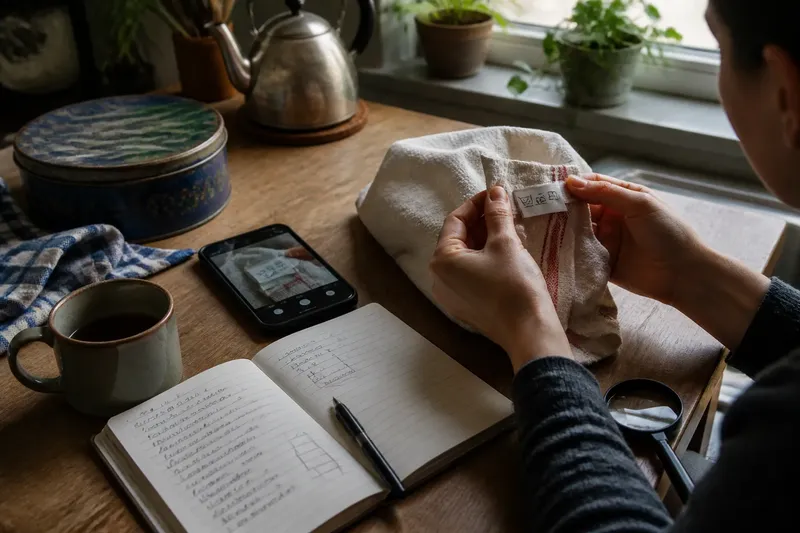
Say you choose a cotton tea towel hanging beside the cooker. You notice a stitched border and a faded care label, then ask a relative who usually uses it. They say it came from a holiday gift shop, but cannot remember which place. Your map can record that account as a memory, the label as something visible and the place as unknown. The object is already more legible, without a confident but unsupported birthplace.
Day one is for materials and visible details
Set aside a short session to inspect the object without dismantling it or putting it through a special cleaning process. Use a table, a notebook and good natural light. A phone camera can help you keep a record of small marks, but the notes matter more than a polished photograph.
Describe materials only as far as you can reasonably tell. “Metal body, rubber grip” may be plain observation; “aluminium” is a stronger claim if you cannot identify it. Use cautious wording such as “appears to be” when the material is uncertain. Record colour, shape, seams, texture, wear and repairs. Note what is missing, too: a label may have peeled away, or the underside may be too worn to read.
Do not treat wear as a travel record. A scuff can show that an object has been handled, but not where that happened. A repair may tell you someone wanted to keep it in use, while leaving the repairer and location unknown. Separate the physical clue from the interpretation in two columns, so the evidence stays visible.
Day two is for labels, marks and careful transcription
Turn the object over and inspect any label, stamp, engraving, care tag, packaging or instruction leaflet that has stayed with it. Copy words exactly, including spelling and punctuation. Record where each mark appears: on the base, along a seam, on a paper tag or on a removable sleeve. A maker’s name, a material description and a place-name are different kinds of information, even when they appear together.
Transcribe rather than translate from memory. If a label uses a language you do not read, note the script and ask a fluent speaker for help if one is available. Keep the original text beside any translation, and identify who supplied the translation. A place named on a label might refer to a company address, a distributor or a manufacturing location; do not assume those meanings are interchangeable.
For a small object, photograph the entire label first and then a close view of the text. Include the object in one image so you can later tell which tag belongs to which item. Avoid rubbing, peeling or taking apart a label to expose hidden marks. If an instruction concerns care or safe use, follow the manufacturer’s wording rather than treating your map as a substitute.
Day three is for the object’s uses at home
Ask the people who use the object what they call it and what they do with it. Keep the questions open: “When do you use this?” is more revealing than “Is this for serving tea?” Someone may use a bowl to hold keys, a scarf as a table covering or a tin to store sewing supplies. The object’s current household role may differ from the role suggested by its shape or packaging.
Record different accounts separately. One person may remember the object arriving as a gift; another may remember it being bought for practical use. Those accounts need not cancel each other out. They describe different parts of its domestic life, and the difference itself can prompt a useful question: did its role change after it entered the home?
Ask whether the object is used alone or as part of a routine shared with others. A serving spoon might appear only at family gatherings; a lunch box might travel between home, school and work. Note the setting and the people involved without turning one household custom into a rule for a whole culture. A small exchange map stays strongest when it describes the household you can actually ask.
Day four is for questions, not a guessed route
With the material, label and use notes together, write down what remains unknown. Useful questions often concern transitions: Who selected the object? Was it bought, given, inherited or passed along? Did its intended use change? Which label refers to the maker, and which refers to a seller? A question is not a blank to fill at any cost; it marks the edge of what your evidence can support.
Sort your notes into three headings: seen, heard and not known. Under “seen”, put direct observations such as a printed name or repaired seam. Under “heard”, record a person’s account in their own terms, with their permission. Under “not known”, put anything that would require more information. This simple separation helps keep a plausible explanation from quietly becoming a fact.
If a family member remembers where an object was purchased, ask what helps them recall it: a gift occasion, a shop bag, a conversation or a photograph. Preserve the distinction between a vivid memory and documentary evidence. Neither needs to be dismissed, but they answer different questions.
Day five is for checking the small claims
Review each sentence in your notes and ask what supports it. “The label says ‘made in’ followed by a place-name” is a report of text. “The object was made there” is a claim about the object that may depend on the label’s meaning and reliability. “The object travelled directly from that place to this home” goes further still, and may have no support at all.
If you want to follow a question, begin with material already attached to the object: its packaging, a receipt kept with it, or a manufacturer’s information that clearly matches its mark or product name. Record what a source actually says, not what you hoped it would say. If a search turns up several businesses with similar names, leave the identity unresolved rather than selecting the most convenient result.
For a shared household object, invite others to correct the map. They may recognise a word, know that a tag was added later or remember that the item belonged to someone else first. Mark edits with the date and the person’s account, rather than erasing the original note. The map records how understanding develops, not just its latest version.
Day six is for a compact exchange map
Bring the notes together on one page. A simple layout can show the object in the centre, with branches for material, visible marks, household use, remembered events and open questions. Draw arrows only where you can explain the connection. An arrow from “gift” to “kitchen shelf” may represent a remembered transition; an arrow from a place-name on a label to the home may imply a route you cannot establish.
Use short captions such as “printed on the base”, “remembered by my aunt” or “use varies by person”. These make the status of each clue easy to see. If a branch rests on an uncertain interpretation, mark it with a question mark or keep it in a separate area labelled “possible meanings”. Do not decorate the map with imagined transport routes simply because a line looks unfinished.
A map can also show that an object’s cultural significance is local and ordinary. A cloth may connect one household to a gifting custom, a craft material, a language on its label or a routine shared over meals. You do not need to claim that it represents a nation or tradition. Describe the specific connection people have identified, and leave broader claims for evidence you do not yet have.
Day seven is for sharing the map without overstating it
Read the map aloud to someone who knows the object. Listen for wording that turns uncertainty into certainty: “came from” may need to become “has a label naming”, while “used for” may need to become “one person uses it for”. Keep the map compact enough to read at a glance, then attach a short note explaining which details are observations and which come from memory.
Sharing the map can be a conversation rather than a display. Place it beside the object and invite a family member to add a missing name or correct a use. If the object belongs to someone else, ask before photographing it or sharing personal stories. A household record can still be useful without being made public.
When you finish, keep one open question rather than forcing a complete route. That question gives the map somewhere honest to go next: perhaps the meaning of a care symbol, the story behind a gift or the difference between a maker’s mark and a seller’s label. A small exchange map is most useful when its edges are as clear as its clues.